The scientific community has witnessed a groundbreaking leap with the unveiling of AI-powered protein structure prediction on an unprecedented scale. Dubbed the "Protein Universe," this revolutionary initiative has successfully mapped over 200 million protein structures, fundamentally transforming our understanding of biological building blocks. This achievement represents more than just a technical milestone—it opens new frontiers in drug discovery, disease research, and our comprehension of life itself.
From obscure sequences to tangible structures, artificial intelligence has bridged what was once an insurmountable gap in molecular biology. The Protein Universe project, developed by DeepMind in collaboration with EMBL's European Bioinformatics Institute, provides researchers worldwide with free access to predicted structures for nearly every cataloged protein known to science. This treasure trove of data includes proteins from plants, bacteria, animals, and other organisms, many of which had never been structurally characterized before.
The implications of this breakthrough cannot be overstated. For decades, determining a single protein's three-dimensional shape required years of painstaking laboratory work using techniques like X-ray crystallography or cryo-EM. Now, AI systems can generate accurate predictions in seconds, offering structural biologists an invaluable starting point for their research. The models achieve remarkable accuracy, often rivaling experimental methods, particularly for proteins with evolutionary relatives in existing databases.
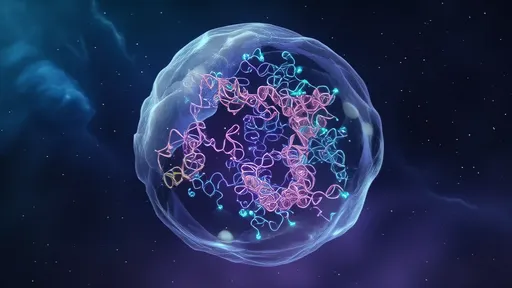
At the heart of this revolution lies AlphaFold, DeepMind's sophisticated neural network that has been trained on the known protein structures in the Protein Data Bank. The system combines physical and biological knowledge about protein structure with multiple sequence alignments to predict the 3D positions of amino acids. What began as an impressive demonstration in the 2020 Critical Assessment of protein Structure Prediction (CASP) competition has now scaled to cover virtually the entire protein space.
The scientific community's response has been nothing short of euphoric. Researchers across diverse fields—from malaria eradication to plastic waste degradation—are already leveraging this resource. Structural biologists report saving months or even years of experimental work, while computational biologists can now test hypotheses about protein function and interaction at scale. The database has become particularly valuable for studying neglected tropical diseases, where research funding has traditionally been scarce.
One remarkable aspect of the Protein Universe is its democratizing effect on science. Previously, structural biology resources were concentrated at well-funded institutions in developed nations. Now, a researcher in a modest laboratory anywhere in the world can access high-quality structural predictions with an internet connection. This levels the playing field and could accelerate discoveries from unexpected quarters of the global scientific community.
The project hasn't been without its critics and limitations. Some researchers caution that predicted structures, no matter how accurate, shouldn't completely replace experimental verification. Certain classes of proteins—particularly those with disordered regions or those that change shape significantly when binding to other molecules—remain challenging for current AI systems. Additionally, the predictions don't include information about ligands, ions, or other small molecules that might interact with the proteins in living systems.
Looking ahead, the Protein Universe represents just the beginning of AI's transformation of structural biology. Researchers anticipate future versions that can predict protein complexes (groups of interacting proteins) and model how proteins interact with DNA, RNA, and small molecules. Some teams are already working on "inverse folding" problems—designing protein sequences that will fold into desired structures—which could revolutionize protein engineering and synthetic biology.
Beyond immediate practical applications, this achievement prompts profound questions about the nature of scientific discovery itself. The Protein Universe demonstrates how artificial intelligence can serve as a powerful microscope for the 21st century, revealing patterns and structures that humans might never have discerned alone. As these tools continue to develop, they may help uncover fundamental principles governing protein folding that have eluded scientists for half a century since Anfinsen's Nobel Prize-winning work.
The ethical dimensions of such powerful technology haven't been overlooked. While DeepMind has made the database freely available, some observers question whether such fundamental biological knowledge should remain entirely in the public domain or if safeguards are needed against potential misuse. The same structural insights that could lead to life-saving drugs might theoretically be exploited to engineer harmful biological agents, though most experts consider the benefits to far outweigh such risks.
As the dust settles on this monumental achievement, one thing becomes clear: we've entered a new era of molecular biology. The Protein Universe hasn't just expanded our catalog of known structures—it has fundamentally changed how we approach biological questions. From accelerating drug development to revealing evolutionary relationships across species, this resource promises to fuel discoveries for decades to come. Perhaps most excitingly, it reminds us how much remains to be discovered in the intricate dance of atoms that constitutes life at its most basic level.
By /Aug 18, 2025
By /Aug 18, 2025

By /Aug 18, 2025
By /Aug 18, 2025
By /Aug 18, 2025
By /Aug 18, 2025
By /Aug 18, 2025

By /Aug 18, 2025
By /Aug 18, 2025
By /Aug 18, 2025
By /Aug 18, 2025
By /Aug 18, 2025
By /Aug 18, 2025
By /Aug 18, 2025
By /Aug 18, 2025
By /Aug 18, 2025
By /Aug 18, 2025

By /Aug 18, 2025
By /Aug 18, 2025

By /Aug 18, 2025
